|
With so many gemological microscopes in the market today, the potential buyer is getting confused, and often misled, by fast-talking sales persons aiming to sell their product, or by other sales people recalling their long history in the gem and jewelry industry. But the bottom line is the quality and performance of the product. The following reflect my thoughts derived from my 25+ years working with gemological microscopes as I have been one of the early gemological instrument makers in the gem and jewelry industry.
The type of light used in the gemological microscopes is of paramount importance. Due to the fact that gemstones are tri-dimensional objects with different optical properties, different types of light are required serving specific purposes. The most important types of light illumination used in the gemological microscope are: |
|
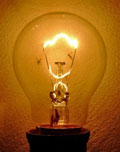
This type of lamp works by incandescence. A thin tungsten wire filament is excited as electrical current passes through, releasing photons in the process. The enclosing glass bulb is filled with gas preventing the hot filament from oxidation. Color temperature range from 2500-2800 degrees Kelvin with life expectancy up to 1,200 hours depending on the components. Incandescent light bulb used in gemological microscopes produce heat, often exceeding 50°C after working continuously for less than an hour. If dimmer is used to control the light intensity, the color temperature of the lamp charges producing a yellowish tinge, an unwanted feature for gemological observations. This type of lamp is no longer used in gemological microscopes by most manufacturers. |
|
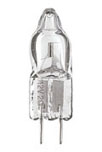
Tungsten halogen lamp is a type of incandescent lamp, where a tungsten filament is sealed into a small envelope filled with halogen gas (i.e. iodine, bromine). That increases the color temperature of the lamp to maximum 3300 degrees Kelvin and its life expectancy to 2000-3000 hours, depending the design and components. Because tungsten halogen lamps get very hot, high melting point fused glass is used. Nearly all gemological microscopes use tungsten halogen quartz lamp for dark-light field illumination. However, the heat problem still remains. Gemlab microscopes do not use tungsten halogen lamp. |
|
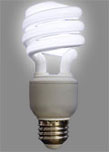
Gas-discharge lamps use electricity to excite mercury vapor in argon or neon gas, resulting in a plasma that produces short-wave ultraviolet light; this light, then, causes a phosphor to fluoresce, producing visible light. The flow of power is regulated with ballast, but the light intensity cannot be regulated. The color temperature range from 5200 to 6500+ degrees Kelvin depending on the components and design. Gemological microscopes use fluorescent lamps as overhead illumination to examine surface irregularities and other features in a gemstone; they are not suitable for diamond color grading. Gemlab microscopes do not use fluorescent lamps. |
|
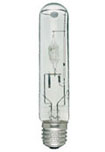
A specially designed gas discharge lamp generates light by sending an electrical discharge through plasma. The character of the gas discharge critically depends on the frequency of the current. Gas discharge lamps may be filled with gas, mercury, metal halides and other material or combination of materials. Color temperature range from 5200 to over 6200+ degrees Kelvin depending on the design and components; they produce very little heat and require electronics to provide the correct current flow through the gas. Specially designed gas discharge lamp may be used for dark/light field illumination in microscopes. Gemlab microscopes do not use discharge lamp. |
|
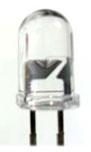
A light-emitting diode (LED) is a semiconductor device that emits incoherent narrow-spectrum light when electrically biased in the forward direction in a form of electro luminescence. LEDs can be made to a specific color temperature depending on the composition and condition of the semi conducting material used. When LEDs are used in gemological microscope where dimming is required, LEDs do not change their color temperature, unlike the incandescent lamps and they do not produce heat. LEDs can last over 100,000 of operation depending on the design and components. Gemlab microscopes use exclusively LED for dark-field and overhead illumination with color temperature 5500° Kelvin. |
|
|
Dark field configuration using parabolic 360 degree reflector and tungsten bulbs are very good and have been used for many decades. However, these microscopes get hot after a short time and it is very uncomfortable to work for long periods of time. In the maxxiLEDscopes the LED bulbs never get hot allow you prolong periods of time for comfortable observations.
Tungsten halogen lamps and LED and the like cannot be used for color stone grading. The LEDs used in microscopy are never intended neither recommended to be used for diamond/gemstone color grading, dichroscopic or spectroscopic applications. There are instruments designed for the specific purpose.
The 32 LEDs used as the ring light to simulate the dark field environment are positioned at 30o angle, thus providing multiple and overlapping illumination that makes the intensity more than 19K cnd power, equally roughly to 28W quartz halogen. That means the maximum intensity of the dark-field is concentrated on the apex of the 32-LED configuration in a similar manner of a 30W GE#993 quartz halogen lamp. So, the light always illuminate the stone at the “correct angle” as long as the stone is within the light paths of the LEDs.
In the dark field illumination, the light intensity depends on: a) the distance between the apex and the stone and b) the position of the stone in focus in relation to apex. That’s the reason large stones are focused in different distance that small stones and that’s why a proper tweezers should be used for proper manipulation of the gem.
In the past, ring light illuminators affixed under the scope’s objective provided overhead illumination commonly using 24 fiber-optic light guides (d=3mm) inclined at 25-30 degrees (similar to LED light arrangement of the GEMLAB microscopes), but the light source (QH 150W) is supplied externally. Great idea, but somewhat it is inconvenient having a hot base supplying the light..
Gemlab microscopes use a group of LEDs to produce dual overhead light: daylight and ultraviolet light. It is not mainly the intensity of the LEDs that makes a faceted transparent stone to look better, but the position which is held under the LED light. |
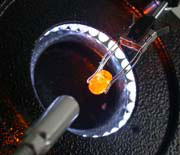
LED dark field illumination
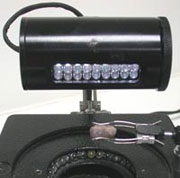
LED overhead white light
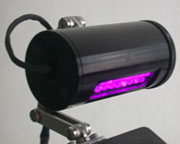
LED overhead ultraviolet light
|
|
| |
| |
|