|
| Course #610 is intense and interactive, covering most issues in ruby-sapphire treatments. During the course, (and at the most appropriate occasion), the following will be presented and performed by all participants: |
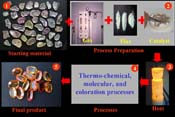 |
- About 60 Power Point presentations conveying the principals and definitions in gem treating technology and methodology
- Video clips on heating rubies-sapphires as performed in Thailand and in Sri-Lanka
|
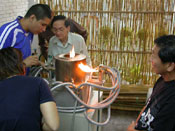 |
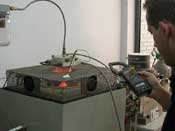
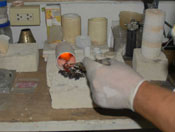
- Demonstration of the the most sought heating processes of blue sapphire using the gas combustion LAKMINI furnace; for ruby, demonstration of electric resistance furnaces (Gemlab models M50, M76, M80).
- Demonstration of treatment processing equipment: instruments, heating elements, ceramics; chemicals and related materials will be provided (not to be taken out of the class)
|
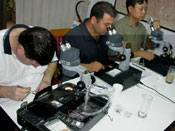 |
Lab sessions include examination of hundreds of untreated-treated rough/cut rubies-sapphires from Burma (Mogok, Mong-Hsu), Madagascar, Mozambique, Tanzania (Umba, Songea, Tunduru, Morogoro, etc), Australia, Nigeria, Congo, Guinea, China, Colombia, Brazil, Sri Lanka, Tajikstan, Nepal, India, Ethiopia, Thailand (Borai, Bang-kha-cha, Kanchanaburi), Laos, Cambodia, Vietnan, and elsewhere. Also, examination of treated synthetic ruby-sapphire; color-asterism surface diffusion on natural-synthetic ruby-sapphire, etc. |
|
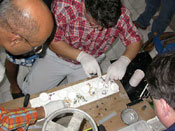
Practical on-hands sessions on treatment runs of ruby-sapphire to be performed by all students:
- PROCESS #1 (HEAT-flux and no flux). Heating selected rubies and pink sapphires from Mozambique, Vietnam, Madagascar, Tanzania, and elsewhere. Prepare and execute a heating process using gas fugacity with/without fluxes.
- PROCESS #2 (HEAT-beryllium): Heating select, rubies-sapphires from Songea, Madagascar, Tunduru, Mozambique and elsewhere. Prepare and execute a "dry" beryllium heating process using a high-temperature electric furnace.
- PROCESS #3 (HEAT-low-temp. no flux): Heating selected rubies-sapphires from different localities using a low-temperature furnace with/without additives
- PROCESS #4 (FRACTURE FILLING): Perform the oiling process of rubies-sapphires
NOTE: Due to time limitations and other restrictions, the actual "Lead-filling" process of ruby will not be performed; however, the related preparation and application process will be discussed in detail. |
|
- Understand corundum as an imperfect crystal
- Review the fundamentals of heat and the effect of heat in gems
- Comprehend temperature measurement (types, description, calibration)
- Learn the concept of oxidizing-reducing atmosphere, buffering & non-buffering reactions, gas fugacity
- Comprehend the influence of gas fugacity in heating gems
- Master the muffle concept and how to obtain precise gas mixtures
- Understand gas technology and gas mixing methodology
- Learn the concept of diffusion phenomenology and differentiate the different types of diffusion
- Be familiar and work with different types of ceramics used in gem treating processes
- Understand the various types of gem treatment equipment
- Learn the various gem treating processes and equipment as practiced in the commercial market:
- Heating, Filling, Irradiation, High-Pressure-High Temperature (HPHT), Impregnation, Bleaching, Coating
- Review briefly the historical aspects in heating ruby-sapphire
- Recognize the various types of treatments of ruby-sapphire
- Plan the strategy in heating ruby-sapphire
- Learn about additives and fluxes: methodology, application, safety & handling, how to prepare and apply flux-melt additives and reagent-grade powers for heating ruby-sapphire
- Develop the skills in understanding the heat-treatment processes of ruby, pink, "padparadscha", orange, yellow, purple/violet, sapphire, yellow, blue, blue/green, green and star sapphire
- Become skilled in setting up the heat-treatment parameters in heating ruby-sapphire
- Learn how to prepare and run a heating process
- Learn about and examine the anatomy of open-flame furnaces (traditional kilns, i.e.coke, lignite, diesel-oxy furnaces, LPG-OXY, etc.) used in heating ruby-sapphire
- Watch a rare documentary videotape "Romancing the Geuda" in heating geuda sapphires filmed in Sri Lanka by Ted in 1985; other documentaries
- Learn the "dry" and "wet" beryllium heating processes of ruby-sapphire (methodology and processes of different types of corundum, inclusion features, handling-safety, stability, disclosure)
- Comprehend the LIBS method in detecting beryllium in heated ruby-sapphire
- Learn the latest treatment of the lead-filled rubies, pink sapphires and examine different types of rubies before/after the treatment
- Be informed on the re-crystallization process of blue sapphires and the heating procedures involved
- Recognize the integrity of the heat-treated ruby-sapphire and maintain consumer confidence with proper detection and disclosure
- Find out how to calculate cost effectiveness ratio and yields before/after the heating process
- Learn how to read a "Gemstone Report" (or "Gem Cert") and understand its real role in the industry
- Be informed on the past and latest prices on rubies-sapphires sold in Thailand and in the USA
|
|
